
 +7 (495) 204-29-64
  +7 (727) 350-81-84
Категории
- Main
- Services
- News
- About the company
- Geography of works
- Blog
- Documentation
- Heat Exchangers
- Shell and tube heat exchangers
- U-tube Heat Exchangers Steam to Liquid (type PPRU)
- U-tube Heat Exchangers Liquid to Liquid (type PVRU)
- Heat Exchangers Steam to Liquid (type PP)
- Heat Exchangers Liquid to Liquid (type PV)
- Heat exchangers steam-water Q
- Coolers condensate
- Heat Exchangers Steam to Liquid (type MVN)
- Heat exchangers water / water Q
- Vertical Heat Exchangers Steam to Liquid (type PSV)
- Heaters of black oil (type PM)
- Oil coolers (type MX)
- Plate and frame heat exchangers
- Capacitive heat exchangers
- Shell and tube heat exchangers
- Water treatment equipment
- Boiler equipment
- Manufacture of bottoms
- Warehouses
Our values
PROFESSIONALISM
Our company employs truly professionals in its field. The average work experience of our employees is 13 years.
ORDERING
The basic principles of our company's work are strict adherence to the terms of the signed contract, fulfillment of obligations under warranty and after-sales service, as well as close interaction with customers based on mutual respect and trust.
OPENNESS
Our company has an open relationship with its partners. We are not afraid to show our production, confirming the fact of manufacturing products in the open access mode on-line.
DEVELOPMENT
We initially chose development as a way to always be ahead and be profitable to differ from competitors. Improvements, effective changes and innovations allow us not only to achieve stability today, but also to lay a serious foundation for future achievements.
Types of heat exchangers

.png)
The process of heat transfer is carried out in heat exchangers, condensers, refrigerators. Depending on the method of heat transfer there are three groups of heat exchangers:
- surface; in which heat is transferred through the surface separating the heat exchanging medium;
- mixing, in which heat from one medium to another is transmitted by direct contact;
- regenerative, in which the environment heated by contact with previously heated solid bodies filling the apparatus and periodically the heating of another coolant.
Surface heat exchangers are shell and tube; element, coil, spiral, of type "pipe in pipe", etc. are the Most common shell-and-tube heat exchangers that are used in high flow low-viscosity liquids or gases. If the fluids have high viscosity and their consumption is small; use heat exchangers type "pipe in pipe". Coil heat exchangers are usually used when small heat loads.
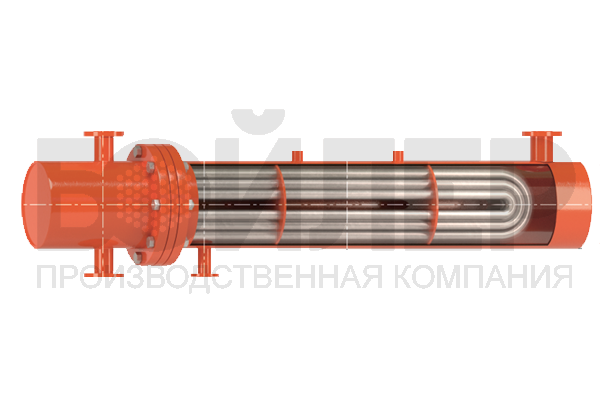 Shell and tube heat exchangers appeared in the early twentieth century in connection with the needs of thermal power plants the heat exchangers with a large surface, such as condensers and water heaters operating at relatively high pressure. Shell and tube heat exchangers are used as condensers, heaters and evaporators. At present their design as a result of special developments taking into account operating experience was much better. In those same years, a broad industrial use of shell-and-tube heat exchangers in the oil industry. For operation in heavy conditions we need heaters and coolers mass, evaporators and condensers for different fractions of crude oil and related organic liquids. Heat exchangers are often used to working with contaminated liquids at high temperatures and pressures, and therefore they had to be designed to provide ease of repair and cleaning.
With years of shell and tube heat exchangers are the most widely used type of apparatus. This is primarily due to the robust design, wide range of versions for various operating conditions, in particular:
- single-phase flow, boiling and condensation in hot and cold stranamente with vertical or horizontal execution;
- pressure range from vacuum to high values.
- widely varying pressure differences on both sides because of the wide variety of options;
- meeting the requirements to thermal stress without increasing the cost of the device;
- sizes from small to very large (5000 m2);
- possibility of using various materials in accordance with the requirements of cost, corrosion, temperature and pressure;
- the use of the developed surfaces of heat exchange tubes inside and outside, different modulators, etc.
- ability to extract tube bundle for cleaning and repair.
Comments ()